

IN DEPTH: The string of murderous attacks that police now blame on the neo-Nazi National Socialist Underground (NSU) lasted more than a decade. The group’s violent downfall and the 10-count murder trial now underway highlight the long-underrated threat of neo-Nazi terror – not only to Germany’s immigrants, but to democracy itself.
Maik Baumgärtner

TERROR TRIAL: Beate Zschaepe enters Higher Regional Court in Munich, Germany, 20 June 2013, to stand trial for the murders and terror attacks of the “National Socialist Underground” terror cell. (NSU). EPA/ANDREAS GEBERT
On 4 Nov. 2011 a bank robbery took place in Eisenach, a town of 43,000 people in the German state of Thuringia. The two male robbers fled on bicycles with about €70,000. Shortly afterwards, police were summoned to a motor caravan by a watchful pensioner. As two police officers approached, they heard gunfire from inside. One of the robbers, Uwe Mundlos, shot first at the officers, then killed his partner, Uwe Böhnhardt, and himself.
Yet the drama continued to unfold. A few hours later in Zwickau, about 200 km east of Eisenach, an apartment exploded into flames. Police soon confirmed that it was the home of the two men and a female comrade, Beate Zschäpe. It was she who set the fire, before disappearing. The trio had been wanted by the police for 13 years, on explosives charges. After four more days on the run, Zschäpe surrendered to the police in her home city of Jena. Two years later she remains in police custody – and silent.
The trial of Beate Zschäpe, now 38, and four suspected supporters began on 6 May this year in Munich – a trial that is expected to last about two years. Up to 500 officials of the German Federal Office of Criminal Investigation (BKA) have taken part in the investigation. Some lawyers and independent experts have repeatedly criticized the authorities for charging only a handful of people in the case. They insist that the evidence implicates additional supporters and contacts.
The victims of terror
The list of actions now attributed to the National Socialist Underground is long: the killing of 10 people between 2000 and 2007, including eight Turkish migrants, a Greek man and a policewoman; 15 robberies between 1998 and 2011; and two bomb attacks in Cologne, in 2001 and 2004, with many serious casualties.
The alleged terrorist cell has never publicly claimed responsibility for the actions. However, investigators found DVDs wrapped with addresses on them in the group’s burnt-out hiding place. On the DVD files, the deeds are thematized in comic style, using the Pink Panther character and photos of dead or dying victims apparently taken by the killers at the crime scenes. In the materials, the killings are described as part of a struggle for the “preservation of the German nation“. The DVD makers urge “actions not words”.
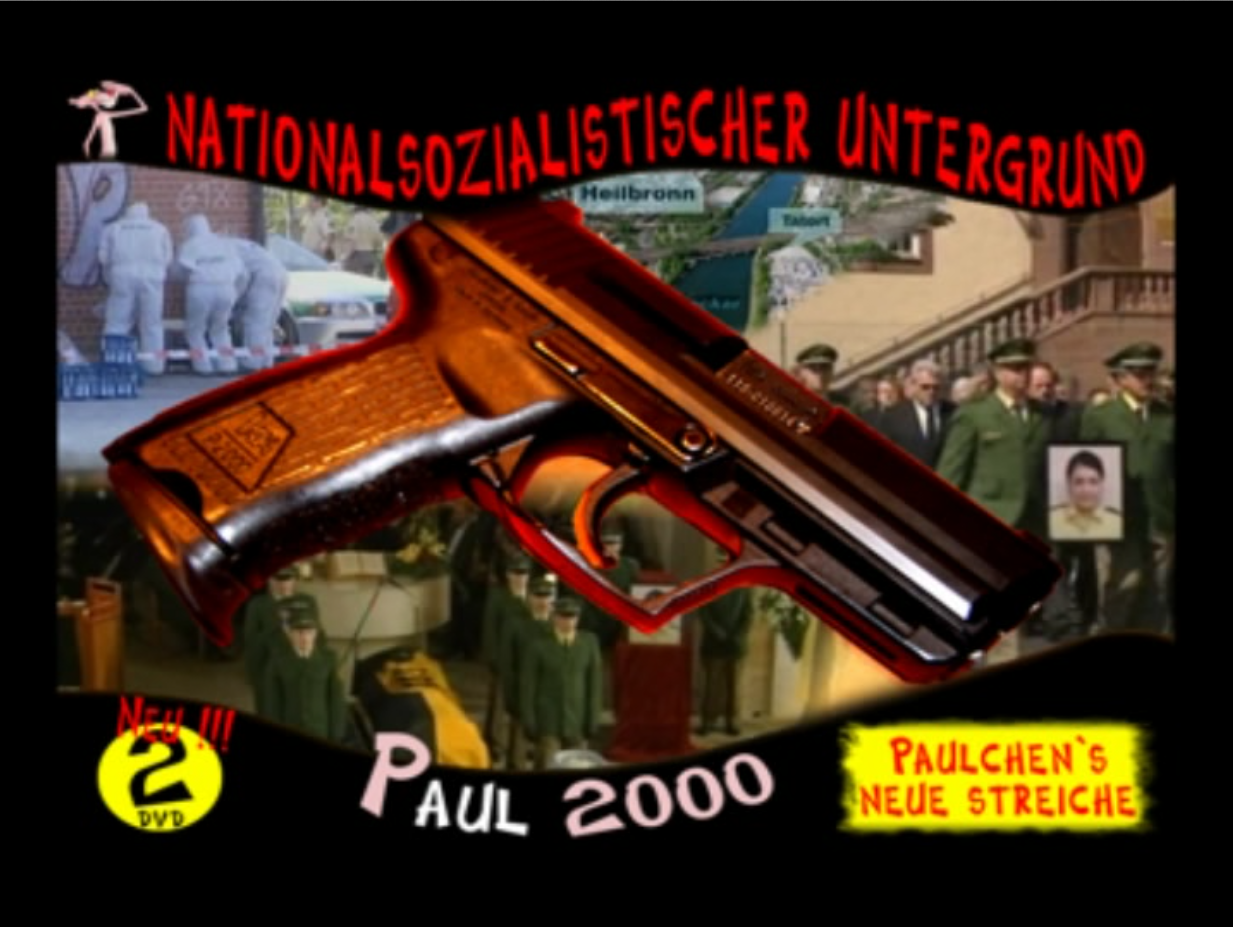
From the DVD material prepared by the NSU terrorists.
It is not fully clear how the victims were chosen. An analysis of investigation files and material from the flat of the three main suspects leads to the assumption, however, that immigrant men of “procreative age“ were singled out, and that additional murders were planned. Among the recovered materials were hundreds of printed and computerized address lists and countless records of observations of shops owned by Turkish immigrants.
The victims were: Enver Şimşek (killed 9 Sept. 2000, Nuremberg), Abdurrahim Özüdoğru (13 June 2001, Nuremberg), Süleyman Taşköprü (27 June 2001, Hamburg), Habil Kılıç (29 Aug. 2001, Munich), Mehmet Turgut (25 Feb. 2004, Rostock), İsmail Yaşar (9 June 2005, Nuremberg), Theodoros Boulgarides (15 June 2005, Munich), Mehmet Kubaşık (4 April 2006, Dortmund), Halit Yozgat (6 April 2006, Kassel) and police officer Michèle Kiesewetter (25 April 2007, Heilbronn).
“How do you like your Turks? Do you like them well done?”
Böhnhardt, Mundlos und Zschäpe came of political age in the early 1990s, a time of many racist murders in Germany. Eastern and western Germany were confronted with a groundswell of violence against migrants committed by Neo-Nazis and racists. A prominent example occurred in Rostock-Lichtenhagen in August 1992. For days, hundreds of Neo-nazis besieged a home of Vietnamese workers and eventually set fire to the building while up to 3,000 neighbouring residents applauded. Nobody was killed in Rostock, but only a few months later three Turkish migrants died in an arson attack in Mölln. The victims were two children and their grandmother. Others were seriously injured.
Worse was to come. In mid-1993, only a few days after a tightening of German asylum laws, five Turkish migrants died in yet another arson attack carried out by neo-Nazis, this time in Sollingen.
The dead of Mölln and Solingen were ridiculed in many neo-Nazi circles. Incendiary attacks and murders sometimes sparked celebration. Song lyrics of bands connected to the “Blood and Honour” network expressed what neo-Nazis of the Böhnhardt-Mundlos-Zschäpe generation thought about such deeds. One of the most notorious contemporary songs was “Barbecue in Rostock”, which asked: “How do you like your Turks? Do you like them well done?” The CD cover showed a drawing of a caricatured Turk on a skewer, being roasted over fire by a neo-Nazi.
In 1987 Blood and Honour, the most significant international neo-Nazi music network until today, was founded in Great Britain. Ian Stuart Donaldson was its mastermind and founder. Before his death in 1993, he had been the lead singer of the neo-Nazi band Skrewdriver, which had a pioneering role in extreme right-wing rock music.
The slogan “Blood and Honour” dates from the time of National Socialism in Germany, and was engraved on the knives of Hitler Youth. The symbol of the network, B&H, resembles a triskelion. The number code 28 is prevalent. It symbolizes the 2nd and 8th letter of the alphabet and stands for Blood and Honour. Nowadays B&H organizes concerts in a number of countries, produces CDs and DVDs and publishes a magazine. In the early 1990s, a German offshoot was established, but was prohibited in 2000.
In 1998, the trio of Böhnhardt, Mundlos and Zschäpe were part of this network and the environment surrounding it. Investigators at the Thuringian State Office of Criminal Investigations said the three belonged to the “hard core” of Blood and Honour.
“Ali Bastard, we hate you”
In January 1998, investigators searched the flats and garages of Böhnhardt, Mundlos and Zschäpe. At that time they were suspected of involvement in sending dummy letter bombs. In the raid, pipe bombs (1.4 kg of TNT), propaganda material, weapons and computer media were confiscated. On a floppy disk, the police found a “poem”, possibly written by Uwe Mundlos. The poem read: “Ali Bastard, we hate you! […] Those who say that this is too mean should see the Turkish swine! He raids, robs and is obnoxious, yet today he is gonna die – what a shame!” (“Ali Drecksau, wir hassen dich. […] Wer sagt das wäre zu gemein – der soll es sehen das Türkenschwein! Er plündert, raubt und wird dann frech, doch heut noch stirbt er – ‘so ein Pech’).
While police were carried out their investigation, the three became fugitives.
There are indications that other participants in the German neo-Nazi scene may have been aware of the NSU’s existence. In 2002, the introductory page of a neo-Nazi magazine contained the sentences: “Many thanks to the NSU, it came to fruition. The struggle goes on.” In May 2012, having discovered this 10-year-old reference to the NSU, police searched the flat of a state parliament representative from the far-right National Democratic Party of Germany. The investigators found an NSU leaflet that they recognized from a file stored on one of the suspects’ computers. Until this discovery, no evidence had surfaced that the leaflet had ever been distributed or sent to anyone. It is now known that the NSU sent this handbill with a donation to the makers of the neo-Nazi magazine. Also suggestive of outside supporters is the song “Döner-Killer” by a German neo-Nazi band, released in 2010. Its lyrics include the line: “He already did it nine times / The SoKo Bosporus sounds the alarm / The investigators are hyped up / A bloody trace and nobody can stop the phantom” (Neun mal hat er es jetzt schon getan. Die SoKo Bosporus, sie schlägt Alarm. Die Ermittler stehen unter Strom. Eine blutige Spur und keiner stoppt das Phantom). And further: “He already killed brutally nine times, but the urge to kill can’t be satisfied” (Neun mal hat er bisher brutal gekillt, doch die Lust am Töten ist noch nicht gestillt).
Underground: Holidays, friends and mail from the East

Wanted poster from 1998.
During their 13 years on the run, the three members took annual holiday trips to the Baltic Sea. There they would spend several weeks bicycling, surfing and card-playing with friends they made in the area. They made the acquaintance of several families with whom they developed casual friendships over the years. The trio visited these families and maintained contact with them via telephone, Skype and emails.
In the summer of 2009 they got to know a family whose other holiday acquaintances had raved about the three young people from eastern Germany. A family member later told the investigators: “They were nice, very pleasant, polite people who did not, however, tell much about themselves.”
After the holiday, this family even received a package from Beate Zschäpe, who used the name Liese as one of her aliases in public. The package, with no return address, contained Thuringian bratwurst, a CD with pictures of the shared holiday and sweets for the two children in the family. Zschäpe cared for animals, too. When she, Böhnhardt and Mundlos went on a journey, she engaged a caregiver for their cats and granted access to the apartment. It was also Zschäpe who stayed in contact with the neighbours in Zwickau, visiting them and spending evenings with them.
Ideological role models
To understand the NSU terror, it is necessary to study possible ideological role models and the international neo-Nazi scene in the 1980s and 1990s. There is reason to believe that the future members of the National Socialist Underground were inspired by militant concepts commonly discussed in international neo-Nazi circles of the time.
The Turner Diaries is one of the most famous books of the extreme right. The novel by William L. Pierce was published in 1978 and contains over 200 pages of the fictional diary of Earl Turner, who is described as going underground in the 1990s with fellow travellers to fight violently against “the system” as a part of a racist and anti-Semitic group. In Pierce’s novel, “The Order” was an inner circle of political leaders in a terrorist organization.

- German-language propaganda material published under the C18 name.
The novel directly inspired an actual U.S. white nationalist terrorist group, which named itself The Order in a tribute to The Turner Diaries. The group, founded by Robert Jay Mathews, was active in 1983 and 1984. In addition to bank raids and bomb attacks, it created death lists containing the names of “foes and enemies“. On 18 June 1984, members of The Order fatally shot the liberal lawyer and anchorman Alan Berg outside his Denver, Colorado, home. Berg had been second on the members’ death list.
The group ceased activities that same year after Mathews died in an exchange of gunfire with FBI officials who had stormed his house. The Order is renowned among German neo-Nazis not only for its actions but for the famous “Fourteen Words” of one of the members, David Eden Lane: “We must secure the existence of our people and a future for White children.”
Lane was sentenced to 190 years in prison for his involvement in Berg’s murder. He died in prison in 2007. The 14 words are still widely quoted by the far right on T-shirts, in song lyrics and as the number code “14” today. Mundlos, Böhnhardt and Zschäpe are also accused of creating so-called death lists. One of the first versions of their video contains a link to the “Fourteen Words”. Fourteen text boxes filled with the dates of the German attacks are used as a graphic element in the NSU video.
All the same, no strategy has had more impact on the formation of militant neo-Nazi groups than the idea of a “leaderless resistance”, developed in 1992 by former Ku Klux Klan activist Louis Ray Beam in the United States.
Perhaps the most famous violent neo-Nazi organization in the world is Combat 18, which has its roots in Great Britain and was founded as the military wing of Blood and Honour. The number 18 represents the first and the eighth letter of the alphabet, or AH, which stands for Adolf Hitler. The logo of the group consists of a white skull on black background. Combat 18 follows the concept of leaderless resistance, which makes it impossible to say how many people or cells are involved. Any group that feels connected to the ideological aims of C18 is permitted to undertake actions in the name of the group.
A number of publications have been issued under the Combat 18 label. In addition to bomb-building instructions and deeply racist and anti-Semitic texts, the group has put out “Redwatch” lists containing names, addresses, pictures and other information on “enemies”. A German magazine called “Stomper”, using the Combat 18 logo, also circulated in Germany. In the introduction, the unknown authors of the internally sold booklet wrote:
Our countries are ruled by the same Jewish “Untermenschen”, whose only interest is to destroy the white race and to annihilate the last drop of Aryan blood. The Jewish rats and their democratic tools are guilty of the proceeding destruction of our race day after day. It is our task to annihilate the Jewish democracy and all its excesses. No matter where, no matter how! It is time for actions!
In the magazine, the slogan “actions not words”, also used by the NSU, appears as a headline. A contact email address supposedly belonging to the magazine’s initiators corresponds to an email address of the official Combat 18 website. A Combat 18 manual called “The political soldier” contains instructions for armed underground struggle. It says: “No cell should join the armed struggle, if it has no safe place to store weapons, munition and collected information.” There is reason to believe that the National Socialist Underground felt a strong connection to C18 and acted according to its tenets.
The nature of the actions attributed to NSU is familiar to observers of neo-Nazi subculture. Terror bombings against migrants and homosexuals were employed in 1999 by the British neo-Nazi David Copeland. Three of his nail bombs killed three people – including a pregnant woman – and injured 129 others. Some victims had to have limbs amputated. Copeland committed his first attack in a district of London with many black inhabitants on 17 April 1999. He placed the bomb, which he had filled with nails measuring 10 cm in length, in a gym bag and left it in front of a supermarket. Fifty people were hurt by the detonation. Exactly one week later he detonated another bomb in an eastern part of London inhabited by many people from Bangladesh. This time 13 people were wounded. The last nail bomb, which went off on 30 April 30, was Copeland’s deadliest. He placed it in the “Admiral Duncan Pub”, which was frequented mostly by homosexuals. It killed three people and injured 79. The police had already publicly circulated a video image of Copeland from the first attack, and eventually arrested him after receiving a tip from a work colleague. According to BBC News, Copeland stated the following about his motivation for attacking migrants: “I don’t like them, I want them out of this country, I believe in the master race.”
In his flat, the police found a copy of the The Turner Diaries. Copeland told the police that he believed in this book and in a coming racial war, which he wanted to trigger with his attacks.
Copeland’s statements tally with a strategy document of a group called “White Wolves”. The author (or authors) of this document – which is dedicated to the founder of The Order and contains instructions for making a simple time fuse – encourages readers to provoke a “race war” by attacking blacks or Asians. The document urges the founding of terrorist cells with a maximum of five members who are dedicated to securing the future of the “white race” violently. Near the end are the words: “If you agree with us, ACT NOW!”
Errors, breakdowns and prejudices: the failure of German security authorities
The list of mistakes that allowed Mundlos, Böhnhardt and Zschäpe to escape arrest for so long is extensive. Numerous informants of several law enforcement authorities were involved as infiltrators in the supportive environment around the NSU members and in the political organizations they had taken part in before going underground. An internal document of the Office for the Protection of the Constitution in Thuringia shows that the secret service knew, at least until 2001, something about who remained in contact with the fugitives and in which region the trio was hiding.
The Besondere Aufbauorganisation (special organizational structure) “Bosporus” – founded in July 2005 to investigate the series of killings – was one of the biggest police task forces in recent German history. Up to 160 officials all over the country were part of this task force’s investigation. But the they mainly followed the wrong leads. According to investigation files, their main focus was “drug scene, organized crime, extreme left- and right-wing Turkish groups or foreign secret services”. Some 30 million data records were analyzed, among them “tens of thousands of data about travel patterns and visa documents of arriving Turks”. Undercover operations were mounted in the environment surrounding the victims’ families. Information about the killings was meticulously collected. But officials paid little attention to the the possibility of a racial or extreme right-wing motivation for the killings, even though a criminal profiler’s analysis had led to the conclusion that the perpetrator or perpetrators may have been part of the “right wing scene”.
Instead of solidly investigating all options, investigators relied on methods not generally associated with the German security services. An Iranian spiritualist who claimed to have contacted the dead, for example, was deployed in the investigation of the Hamburg killing. He claimed that the victim, from the beyond, had given him a description of the murderer: “The offender is said to have a dark complexion (Southern European), brown eyes and black hair. He is very young and could be a Turk.” This quotation is taken from the files of the investigation. The description corresponded to the expectations of the investigators.
Apart the lengthy work of a federal investigation committee, political leaders from the states of Bavaria, Saxony and Thuringia are seeking to clarify the official failures. But what will be done? Shortly after the NSU’s alleged responsibility became public last November, some elected officials began calling for a ban of the extremist National Democratic Party of Germany as well as for the establishment of a centre to defend against right-wing terrorism and a central database of violent neo-Nazis. Although the state in past years has demonstrated strength by banning right-wing extremist organizations, the situation has not significantly changed.
Neo-Nazis still kill, harm and agitate. Their numbers are not declining; the circles of violence are growing; and racism and Islamophobia are widespread. Shortly after the terror cell became public, neo-Nazi followers began ridiculing the victims on T-shirts, alluding to the NSU actions in demonstrations and interviews and sympathizing with the defendants – all despite intensive media attention and state repression.
To call things as they are
To prevent more racist and right-wing extremist murders and attacks, it will first be necessary for the authorities and society at large to discuss the problem openly and determine its scope. The problem is racism, and the discussion must extend to the behaviour of investigators and the media. In 2004, after a bomb exploded outside a hairdressing salon in an area of Cologne crowded with immigrants, the salon owner told a sceptical reporter: “I believe in a xenophobic motivation and you don’t.” Now it seems clear that bomb was indeed planted by the NSU. Measures against racism and discrimination must be taken at all levels.
 Print Friendly




[…] succeeds, the NPD will be gone, but Germany’s right-wing extremist subculture – which has also fostered terrorists – will […]